Last updated:
Quick answer: For most Snohomish County homes, a heat pump is a strong choice. Our winters are mild and damp, which suits heat pumps well, and a heat pump also gives you air conditioning in summer. A gas furnace still makes sense if you want very hot air on the coldest nights. A dual-fuel system pairs a heat pump with a furnace and gives you both.

Choosing a new heating system is a big decision. Here is a plain-language comparison to help you decide.
How each system works
A furnace burns natural gas or propane, or uses electric heating elements, to make heat. It delivers very warm air quickly. It only heats, so you need a separate air conditioner for summer.
A heat pump moves heat instead of making it. In winter it pulls heat from the outdoor air and moves it inside. In summer it reverses and works as an air conditioner. One system covers both seasons.
Why heat pumps fit our climate
Snohomish County winters are cool and wet, with only occasional hard freezes. That is the kind of weather where heat pumps run efficiently most of the season. Today’s cold-climate heat pumps keep heating even when temperatures drop well below freezing.
Summers have changed, too. The June 2021 heat wave showed how many Pacific Northwest homes have no cooling at all. A heat pump solves that without adding a second system.
When a furnace still makes sense
- You have natural gas and want the hottest possible air on the coldest days.
- Your current furnace is newer and only your air conditioner needs replacing.
- Your electrical panel would need a costly upgrade to support a heat pump.
The best of both: dual fuel
A dual-fuel system pairs a heat pump with a gas furnace. The heat pump handles most of the year. When it gets very cold, the furnace takes over. We recently added a cold-climate heat pump to an existing furnace in a Bothell home to fix uneven heating between the main floor and upstairs.
No ductwork? Consider ductless
Older homes, additions and garages often have no ducts. A ductless mini split heat pump heats and cools room by room with no ductwork needed.
Questions to ask any installer
- Will you do a load calculation, or just match my old system size?
- Is the heat pump rated for cold-climate performance?
- Do you recommend backup heat or dual fuel for my home?
- What does the warranty cover, and who handles service?
- Do you offer financing?
How Altitude Heating & Cooling helps you choose
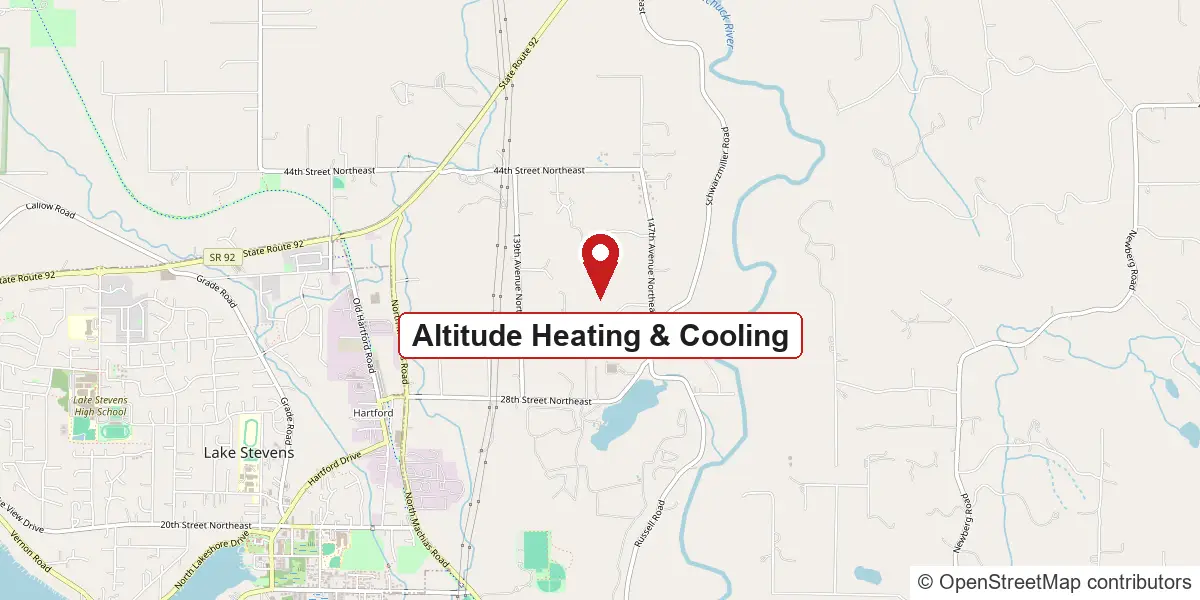
Altitude Heating & Cooling installs heat pumps, furnaces, dual-fuel systems, air conditioners and ductless mini splits across Lake Stevens, Snohomish, Everett, Marysville, Granite Falls, Monroe, Lynnwood and Mukilteo. We look at your home, your ductwork, your electrical panel and your budget, then give you clear options side by side.
We size every system for your home, install it clean and walk you through how it works before we leave. Financing is available on new systems.
Ready to compare options? Call 425-201-1998 for a free estimate, or book our $49 HVAC diagnostic and maintenance visit if you want your current system checked first.
Frequently asked questions
Do heat pumps work in Washington winters?
Yes. Snohomish County winters are mild enough for heat pumps to work well most of the year, and cold-climate models keep heating below freezing.
Does a heat pump replace my air conditioner?
Yes. A heat pump heats in winter and cools in summer.
Is a heat pump cheaper to run than a gas furnace?
It depends on local gas and electric rates and on your home. We compare both for your home during the estimate.
Can I keep my furnace and add a heat pump?
Yes. That is a dual-fuel system, and it is a popular upgrade in our area.