Last updated:
Quick answer: Repair your furnace if it is less than about 15 years old and the problem is a single, affordable part. Replace it if it is 15 years or older, needs a major part such as a heat exchanger, or keeps breaking down. A simple rule of thumb: multiply the furnace age by the repair cost. If the number is over $5,000, replacement is usually the better value.

Nobody wants to buy a furnace they do not need. Nobody wants to keep paying to fix one that is worn out, either. Here is how to make the call with confidence.
The age test
Most furnaces last roughly 15 to 20 years with regular maintenance. A furnace under 10 years old is almost always worth repairing. Between 10 and 15 years, it depends on the repair and the condition of the system. Past 15 years, every repair is money spent on equipment near the end of its life.
The $5,000 rule
Multiply the age of the furnace by the repair estimate. A 16-year-old furnace with a $400 repair scores 6,400, which leans toward replacement. An 8-year-old furnace with the same repair scores 3,200, which leans toward repair. It is not a hard law, but it is a useful starting point.
Signs a repair will not solve the real problem
- You have needed more than one repair in the last two years.
- Your heating bills keep climbing even though your habits have not changed.
- Some rooms are always cold no matter what the thermostat says.
- The furnace short cycles, turning on and off every few minutes.
- You see rust, soot or a yellow, flickering burner flame instead of a steady blue one.
When replacement is the safer call
A cracked heat exchanger is the clearest example. The heat exchanger keeps combustion gases separate from the air you breathe. When it cracks, carbon monoxide can get into your home. In most cases the safe answer is a new furnace. We recently found one in a Marysville home after short cycling that the homeowner thought was minor.
What a good furnace replacement includes
- A load calculation to size the furnace for your home, not a guess based on the old unit.
- A check of your ductwork, because a new furnace on leaky ducts still wastes heat.
- Options at different price points, such as single-stage, two-stage or variable-speed furnaces.
- A look at whether a heat pump or a dual-fuel system makes more sense for your home.
- A clean install, a full startup test and a clear walkthrough of your new system.
How Altitude Heating & Cooling helps you decide
At Altitude Heating & Cooling, we start with the facts. Our technician diagnoses the problem, checks the age and condition of your furnace and tells you honestly whether a repair makes sense. We never push a replacement when a repair will do the job.
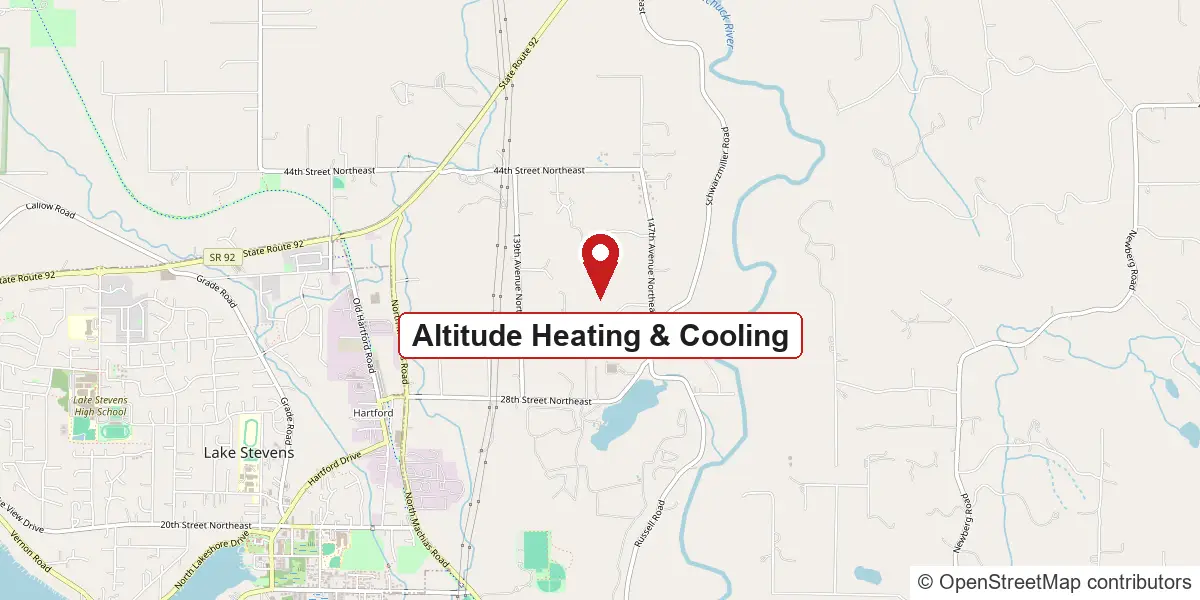
If replacement is the better value, we show you options that fit your budget, from efficient single-stage furnaces to quieter two-stage systems and heat pump or dual-fuel upgrades. Financing is available. We serve Lake Stevens, Snohomish, Everett, Marysville, Granite Falls, Monroe, Lynnwood, Mukilteo and nearby communities.
Not sure where your furnace stands? Book our $49 HVAC diagnostic and maintenance visit or call 425-201-1998 for a free estimate on a new system.
Frequently asked questions
How long does a furnace last in Washington?
Most furnaces last roughly 15 to 20 years. Regular maintenance helps yours reach the high end of that range.
Is it worth repairing a 20-year-old furnace?
Usually not, unless the repair is very small. At that age, efficiency is lower and more parts are close to failing.
Can a cracked heat exchanger be repaired?
In most cases, no. Because of the carbon monoxide risk, replacing the furnace is the safe choice.
Should I replace my furnace with a heat pump?
For many Snohomish County homes, yes. A heat pump heats and cools with one system. A dual-fuel setup keeps a furnace as backup for the coldest days.